Spinach Nutrition: Protein, Calories & Raw vs Cooked
One cup of raw spinach (30g) has just 7 calories and 0.9g of protein; one cup of cooked spinach (180g) has 41 calories and 5.4g of protein. Cooking collapses the volume — you eat far more spinach per cup cooked. It is one of the most nutrient-dense vegetables per calorie, loaded with vitamin K, vitamin A, and folate. For the complete picture — vitamins, minerals, and the raw-vs-cooked volume trick — read on.
🧮 Calorie Calculator 🥗 Healthy Foods List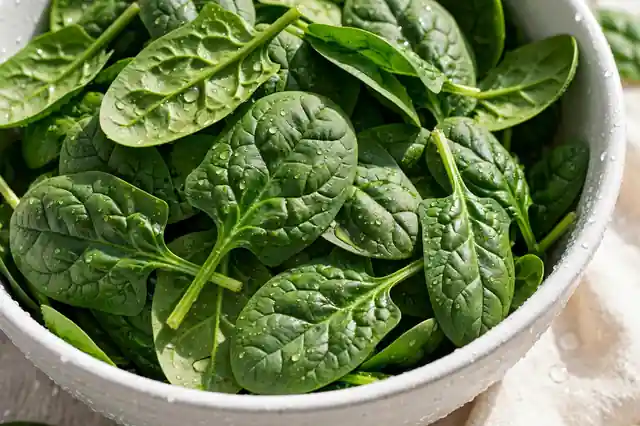
Full Nutrition Facts (USDA FoodData Central, per 100g)
The table below compares spinach nutrition per 100g, raw versus cooked (representative values).
| Nutrient | Raw | Cooked (boiled, drained) |
|---|---|---|
| Calories | 23 kcal | 23 kcal |
| Protein | 2.9g | 3.0g |
| Carbohydrates | 3.6g | 3.8g |
| Fiber | 2.2g | 2.4g |
| Fat | 0.4g | 0.3g |
| Vitamin K | 483mcg | 541mcg |
| Vitamin A | 469mcg RAE | 524mcg RAE |
| Folate | 194mcg | 146mcg |
| Vitamin C | 28mg | 10mg |
| Iron | 2.7mg | 3.6mg |
| Magnesium | 79mg | 87mg |
| Potassium | 558mg | 466mg |
| Calcium | 99mg | 136mg |
| Lutein + zeaxanthin | 12,000mcg+ | Similar per 100g; far more per cup |
Raw vs Cooked: The Real Story
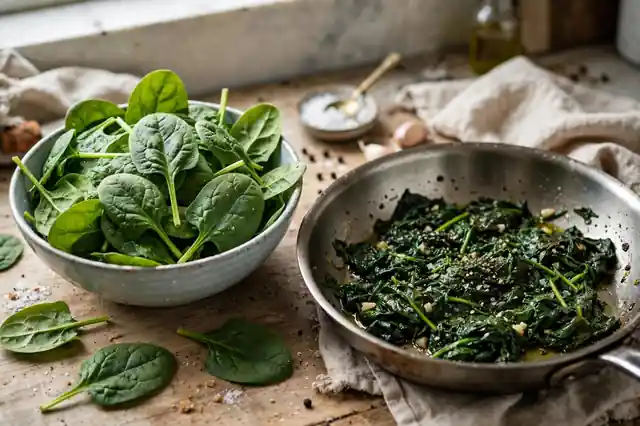
Per 100g, raw and cooked spinach provide similar calories and protein, but the profiles differ — cooking cuts vitamin C and folate and shifts several minerals (see the table). The difference is volume: a cup of raw spinach is 30g (7 cal, 0.9g protein); a cup of cooked is 180g (41 cal, 5.4g protein). Cooking wilts roughly 6 cups of raw leaves into 1 cup cooked (it varies with the leaves and method), so cooked spinach delivers far more nutrition per serving simply because you eat more of it.
Trade-offs of cooking:
- Loses: vitamin C and folate (heat- and water-sensitive), some potassium.
- Gains: more iron and calcium per cup (you simply eat more spinach), and boiling and draining reduces some soluble oxalate, which can otherwise bind minerals — though this does not guarantee a specific absorption boost.
- Gentler method: steam or sauté briefly instead of long boiling — typically keeps more folate and vitamin C.
Does Spinach Have Protein?
Yes, but modestly: 2.9g per 100g raw. A realistic serving, 2 cups raw in a salad (60g), gives ~1.7g; a cup of cooked gives 5.4g. Spinach is not a protein source to build a diet on, but among vegetables it is respectable, and its protein comes with almost no calories. That modest protein is one small part of the story — the vitamins and minerals are the headline. For a “vegetables high in protein” angle: it beats lettuce, cucumber, and celery, but loses to peas, edamame, and broccoli.
The Iron Question
Spinach’s famous iron content (thanks, Popeye) is real but non-heme iron, which the body absorbs less efficiently than heme iron from meat — absorption varies widely with your iron status and the rest of the meal. Two fixes: eat spinach with vitamin C (lemon juice, bell peppers, tomatoes), which can substantially improve non-heme iron absorption; and know that cooking (especially boiling and draining) reduces some oxalates that can bind minerals, though the effect varies by method. That vitamin-C pairing is the simplest way to unlock more iron from spinach nutrition. Spinach contributes to iron intake but should not be anyone’s primary iron strategy.
Eye Health: Lutein and Zeaxanthin
Spinach is one of the richest sources of lutein and zeaxanthin, carotenoids that accumulate in the retina. Higher intakes are linked with lower age-related macular degeneration risk in observational research — an association, not proof that spinach prevents it. They are fat-soluble, so spinach sautéed in olive oil or dressed with oil helps your body absorb more of them than fat-free preparations.
Nitrates and Blood Pressure
Spinach is naturally high in dietary nitrates, which the body converts to nitric oxide, a vasodilator. This is the same pathway behind beetroot juice’s studied blood-pressure effects, and leafy greens share it. Research on dietary nitrates and blood pressure is ongoing and results are mixed, though — spinach fits a blood-pressure-friendly eating pattern (less sodium, more potassium), but it is not proven to lower blood pressure on its own.
Spinach, By Goal
For Weight Loss
Spinach is nearly a freebie, calorie-wise: an enormous salad bowl of 100g raw is 23 calories. On pure spinach nutrition density per calorie, few vegetables compete, which is exactly why it works as a cut’s volume base. Use it as a volume base on a cut: big spinach salads with a real protein source (tuna, chicken, eggs) and a measured dressing. The fiber and volume help you feel full; the protein source does the heavy lifting.
For Weight Gain
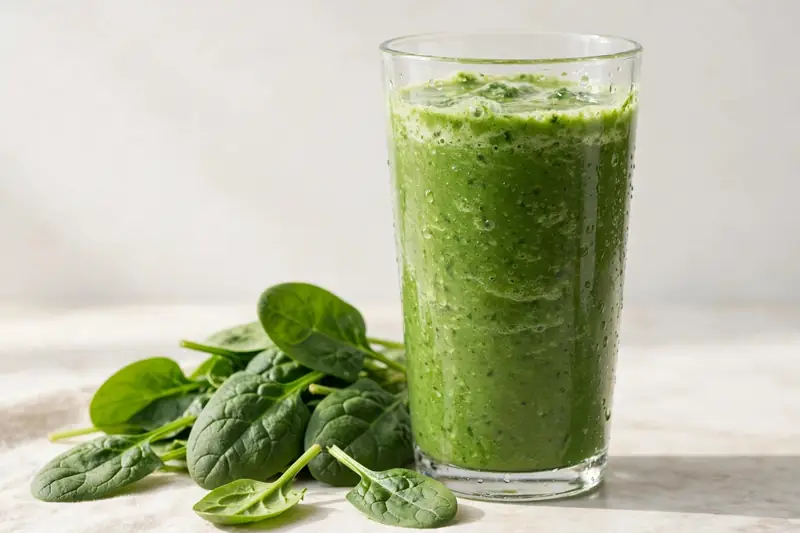
Spinach will not drive a surplus, it fills you up for almost no calories. During a bulk, treat it as a micronutrient side, not a meal base: wilt a cup into pasta, blend into smoothies (you will not taste it), or sauté as a side. Do not build large raw salads when every bite of fullness counts.
For General Health
If there is one “eat more of this” vegetable, spinach is a strong candidate: exceptionally high vitamin K, vitamin A, and folate, plus meaningful magnesium and potassium, all for ~23 calories per 100g. Rotate with kale, broccoli, and arugula for variety.
How Much Spinach Per Day?
1-2 cups cooked (or 3-4 cups raw) daily is a reasonable, realistic amount — there is no official spinach target, and variety matters more. More is fine for most people, with two cautions: if you take warfarin, the vitamin K matters — keep your intake consistent day to day and do not suddenly change it without telling your doctor (you do not need to avoid spinach); and the oxalates matter for people prone to calcium oxalate kidney stones.
Frequently Asked Questions
Is spinach really a superfood?
On the full spinach nutrition scorecard — vitamins, minerals, nitrates, lutein — it earns the label better than most: top-tier vitamin K, A, and folate density per calorie, plus lutein and nitrates with real mechanisms. Still, variety across vegetables beats any single one.
Which is healthier, cabbage or spinach?
Spinach, by most measures: far more vitamin K, A, folate, and iron per calorie. Cabbage wins on vitamin C per serving and price. Eat both.
What is the healthiest vegetable?
No single winner. Spinach sits in the top tier alongside kale, broccoli, and Brussels sprouts — and watercress actually tops some nutrient-density rankings (the CDC’s powerhouse list). Variety beats any single winner.
Can you eat too much spinach?
For most people, no. People taking warfarin should keep vitamin K intake consistent; people prone to calcium oxalate kidney stones may need advice on high-oxalate foods; and anyone with iron deficiency should not rely on spinach alone for iron.
How much protein is in a cup of spinach?
Raw: ~0.9g per cup (30g). Cooked: ~5.4g per cup (180g). Either way, it delivers those grams with almost no calories attached.
Spinach nutrition is top-tier for vitamins K and A, folate, and nitrates — eat it cooked or with vitamin C to get more from its minerals, and rotate with other vegetables.
Sources
- USDA FoodData Central: Spinach, raw; Spinach, cooked, boiled, drained (representative nutrient values).
- CDC: Powerhouse fruits and vegetables classification.
This article is for general information only and is not medical advice. Talk to a registered dietitian or your doctor about your personal nutrition needs, especially if you take blood thinners.