Protein Calculator: How Much Protein Do You Really Need?
People who train regularly generally do best on 1.4–2.0g of protein per kg of body weight daily, well above the 0.8g/kg RDA, which is a minimum for sedentary adults, not an optimum. Use the protein calculator below: enter your weight and goal, and it returns your personal daily target. A 70kg person building muscle needs roughly 112–154g per day.
🧮 Calculate My Protein 🥗 Browse Healthy Foods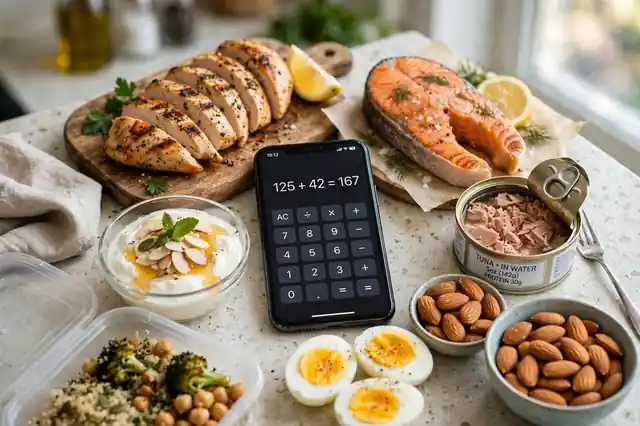
Protein Calculator
How much protein do you need per day? Based on your weight and goal.
Estimate only — not medical advice. Spreading protein across 3–5 meals can make it easier to meet your daily target.
Your Protein Target by Goal
This is the core logic the tool uses. Protein needs are set per kilogram of body weight, and the multiplier depends on your goal.
| Goal | Protein per kg | Example: 70kg person | Example: 90kg person |
|---|---|---|---|
| General health (sedentary) | 1.0–1.2 g/kg | 70–84g | 90–108g |
| Weight loss (keep muscle) | 1.6–2.2 g/kg | 112–154g | 144–198g |
| Muscle building | 1.6–2.2 g/kg | 112–154g | 144–198g |
| Endurance training | 1.2–1.6 g/kg | 84–112g | 108–144g |
The official RDA is 0.8g/kg, but that is the minimum to avoid deficiency in sedentary adults, not the amount for best results. The International Society of Sports Nutrition (ISSN) position stand supports 1.4–2.0g/kg for active people, and up to 2.2g/kg during calorie deficits to protect muscle.
Your Target, By Goal
Protein for Weight Loss
When you eat fewer calories than you burn, your body wants to break down muscle along with fat. Higher protein is the main defense: at 1.6–2.2g/kg, you preserve significantly more lean mass while losing fat, per NIH-published trials. Protein is also the most filling macronutrient, so a high-protein deficit is simply easier to stick to. This is why the calculator gives weight-loss users the top of the range, not the middle.
Practical target: if you weigh 80kg and are cutting, aim for ~130–175g of protein daily.
Protein for Muscle Gain
Muscle protein synthesis, the process of building new muscle, runs on amino acids, especially leucine. Research (Morton et al., published via NIH) found muscle gains keep increasing up to about 1.6g/kg/day, with a practical ceiling around 2.2g/kg. Beyond that point, the returns shrink fast, and extra protein mostly just adds calories.
Practical target: if you weigh 80kg and are training hard, ~130–175g daily, spread across 3–5 meals with 25–40g each.
Protein for General Health
Not training? You still need more than the 0.8g/kg minimum, especially after age 40, when muscle loss (sarcopenia) accelerates. The protein calculator’s general-health range of 1.0–1.2g/kg is a realistic floor for sedentary adults who want to maintain strength and bone density as they age.
How This Protein Calculator Works
The formula is intentionally simple, body weight × goal multiplier, because that is what the sports-nutrition research actually supports. No black box.
Worked Example: Maria, 68kg, Lifting 4x/Week
Maria weighs 68kg and wants to build muscle. The tool applies the muscle-building range:
- Low end: 68 × 1.6 = 109g/day
- High end: 68 × 2.2 = 150g/day
- Her practical target: ~120–140g/day
Her day: Greek yogurt + oats breakfast (30g) · chicken breast + rice lunch (40g) · tuna + potato dinner (35g) · eggs + fruit snack (20g) = 125g total. No supplements needed.
Best Protein Sources (Hit Your Number With Real Food)
| Food | Serving | Protein |
|---|---|---|
| Chicken breast | 100g cooked | 31g |
| Tuna (canned, water) | 1 can (5 oz) | 28g |
| Greek yogurt | 170g | 17g |
| Salmon | 100g | 22g |
| Eggs | 2 large | 12g |
| Ground beef (90%) | 100g cooked | 26g |
| Peanut butter | 2 tbsp | 8g |
| Almonds | 1 oz | 6g |
Animal proteins are complete (all essential amino acids); most plant proteins need pairing (rice + beans, peanut butter + bread). Our healthy foods list covers all of these in detail.
Spread It Across the Day
A daily protein intake calculator gives you the total; spreading it across 3 to 5 meals is what makes the total actually work.
Most lifters do well with roughly 20–40g of protein per meal across 3–5 meals, rather than 100g at dinner and crumbs elsewhere. Each dose triggers muscle protein synthesis for a few hours. A simple pattern: protein at breakfast (most people skip this), protein at lunch, protein at dinner, one protein snack.
Breakfast is the biggest missed opportunity. The typical breakfast, toast, cereal, or coffee alone, delivers under 10g of protein, leaving muscle protein synthesis switched off until lunch. Adding Greek yogurt, eggs, or a scoop of whey to your morning routine is often the single easiest upgrade to your daily total.
Total Weight vs Lean Body Mass: Which Should You Use?
The standard method multiplies your total body weight by the goal multiplier, simple and accurate enough for most people. But if you carry significant extra body fat, total weight overestimates your needs, because fat tissue needs far less protein than muscle.
The refined approach: multiply your lean body mass (total weight minus fat weight) instead. At 100kg and 30% body fat, your lean mass is ~70kg, and 70 × 2.0 = 140g is a better target than 100 × 2.0 = 200g. You don’t need a lab test, a visual estimate or a smart scale gets you close enough. If you’re unsure, use total weight and pick the lower end of your goal range; the difference only matters at higher body-fat levels.
Is 100g of Protein a Day Too Much?
For most adults, no, 100g is below the target for anyone over ~60kg who is active. For a small sedentary person (50kg), 100g equals 2.0g/kg, which is at the top of the range but still within ISSN guidance. For healthy adults, research does not show that protein intakes in this range harm the kidneys. People with existing kidney disease are the exception and should follow their doctor’s guidance.
Embed This Protein Calculator
Run a gym, blog, or coaching site? Embed this free protein calculator, just keep the credit link.
<iframe src="https://eatbygoals.com/protein-calculator" width="100%" height="600" frameborder="0"></iframe>
<p><a href="https://eatbygoals.com/protein-calculator">Protein Calculator</a> by EatByGoals</p>

Frequently Asked Questions
How much protein do I need per day?
Sedentary adults: ~1.0–1.2g/kg. Active, losing fat, or building muscle: 1.6–2.2g/kg. A 70kg lifter needs roughly 112–154g daily. The protein calculator above gives your exact number.
Is 100g of protein a day too much?
No, for most active adults it’s below target. Only very small sedentary people would find 100g at the top of their range, and it’s still within safe guidance.
How much protein do I need to lose weight?
1.6–2.2g per kg of body weight, the high end protects muscle during a calorie deficit and keeps hunger down.
Can I get enough protein without supplements?
Almost always yes. The worked example above hits 125g from ordinary food. Protein powder is convenience, not a requirement, useful on busy days or for big appetites, but no food’s protein is nutritionally superior to what you’d get from chicken, eggs, or yogurt.
What happens if I eat too much protein?
In healthy people, excess protein is simply used as energy, expensive energy. Stay hydrated. People with kidney disease should follow their doctor’s limits.
Do I need protein right after a workout?
The “30-minute anabolic window” is mostly myth. Total daily protein and per-meal distribution matter far more than exact post-workout timing, just eat a protein meal within a few hours of training. If you train fasted in the morning, that post-workout meal matters more, so prioritize 30–40g of protein in the meal that follows.
Sources
- USDA FoodData Central: protein values for foods listed.
- NIH (PubMed): ISSN position stand on protein and exercise; Morton et al. meta-analysis on protein intake and muscle gains.
- USDA Dietary Guidelines for Americans: protein food group recommendations.
This article is for general information only and is not medical advice. Talk to a registered dietitian or your doctor about your personal nutrition needs.