
Honey Nutrition
Honey Nutrition: Is Honey Healthy? Benefits & Facts
A tablespoon of honey has about 64 calories and 17g of sugar. It is still sugar, with small amounts of compounds that table sugar lacks. Here are the full facts, the fair honey-vs-sugar comparison, and the one safety rule that matters most.
🍯 See the Facts 🍽️ Gain Weight Foods
Honey nutrition per tablespoon (21g): about 64 calories and 17g sugar. Honey is primarily sugar. Some varieties contain small amounts of polyphenols and show antibacterial activity under specific conditions, but these properties do not make honey a health food or a proven general treatment. Its composition varies by floral source and processing. Raw and manuka honeys have specific niches, covered below, and honey must never be given to babies under 12 months.
Full Honey Nutrition Facts (USDA, per 100g / per tablespoon)
| Nutrient | Per 100g | Per tbsp (21g) |
|---|---|---|
| Calories | 304 kcal | ~64 kcal |
| Carbohydrate | 82.4g | 17.3g |
| Total sugars | 82.1g | 17.2g |
| Protein | 0.3g | 0.06g |
| Fat | 0g | 0g |
| Vitamin C | 0.5mg | 0.11mg |
| Calcium | 6mg | 1.3mg |
| Iron | 0.42mg | 0.09mg |
Values are based on a generic USDA honey entry, scaled to a 21g serving. Actual values vary by honey type and product. Vitamins and minerals are present in small amounts and are not significant sources at typical serving sizes. Honey is mostly sugar, with small amounts of other compounds, including polyphenols and enzymes; their levels vary by type and processing, and their presence does not make honey nutritionally necessary.
Honey vs Sugar: The Honest Comparison
| Per tablespoon | Honey (21g) | Granulated sugar (12.6g) |
|---|---|---|
| Calories | ~64 kcal | ~49 kcal |
| Total sugars | ~17g | ~12.6g |
| Glycemic index | Varies widely by floral source | Varies by testing method |
| Polyphenols | Small amounts | None |
| Taste | Stronger flavor | Neutral |
| Price | Higher | Cheap |
The servings have different weights, which is why a tablespoon of honey carries more calories and sugar than a tablespoon of granulated sugar. Honey and white sugar are both added sweeteners. Honey contains small amounts of compounds that plain sugar does not, but that does not establish a meaningful overall health advantage, and honey is not reliably lower in glycemic index than table sugar; reported GI values for honey span a wide range depending on the type. Any calorie saving depends on how much sweetener you actually use, not on the swap alone.
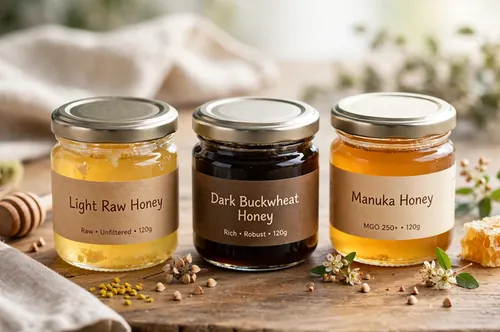
Raw vs Processed vs Manuka
- Raw honey: Generally less processed than conventional honey, but the meaning of “raw” varies by producer. Heating and filtration practices affect enzyme activity and pollen content. There is no established need to choose raw honey for better general health.
- Processed honey: Commercial honey may be heated or filtered for handling, clarity, and shelf stability. Sufficient heating can reduce the activity of some enzymes, but the extent depends on the conditions. Both raw and processed honey are primarily sources of sugar.
- Manuka honey: Produced from the nectar of mānuka plants, commonly associated with New Zealand, and graded by systems such as MGO and UMF. Some specifically prepared medical-grade honey dressings are used in wound care, but evidence varies by wound type. Ordinary food-grade honey should not be applied to wounds as a substitute for medical treatment.
- “Honey-flavored syrup”: Not honey. Check the label; real honey lists one ingredient.
What Honey Can Actually Do
- Cough relief: Honey may help ease acute cough symptoms and improve sleep in children aged 12 months and older. A Cochrane review found benefits compared with placebo or no treatment over short periods, but honey may make little or no difference compared with dextromethorphan, and the evidence is limited. Honey must never be given to children younger than 12 months.
- Wound care: Some regulated, medically prepared honey dressings are used by clinicians for selected wounds, including certain burns and ulcers; the evidence varies by wound type. Do not apply ordinary kitchen honey to a wound or use honey dressings in place of professional assessment and care.
- Allergies: The “local honey cures hay fever” claim is popular but unproven in trials. Enjoy it, but do not expect allergy relief.
- Blood sugar: Honey contains substantial amounts of sugar and can raise blood glucose. Its glycemic response varies by type and serving size, so it should not be assumed to have a meaningful blood-sugar advantage over table sugar. People with diabetes should count its carbohydrates and follow their individual care plan.
The One Hard Rule: No Honey for Babies
Honey can contain Clostridium botulinum spores. In infants younger than 12 months, these spores can grow in the intestines and produce a toxin that causes infant botulism, a potentially life-threatening illness. The CDC advises: never give honey or foods containing honey to a baby under 1 year, and never put honey on a pacifier. This is the single most important honey safety fact.
For Weight Loss
Honey is not a weight-loss food: a 21g tablespoon provides about 64 calories, mostly from sugar. If you replace another sweetener with honey, any calorie reduction depends on using less of it. Measure portions rather than free-pouring, and count honey inside the full meal or drink, not as a free extra.
For Weight Gain
Honey can add calories and carbohydrates to oatmeal, smoothies, or toast: about 64 calories per tablespoon. It is one easy option for increasing energy intake, but it supplies little protein or other essential nutrients, so build the surplus on meals first. Honey also provides carbohydrates that can contribute to exercise fuel; whether it helps around training depends on the session’s duration, intensity, and timing.
For Muscle Building
Honey provides carbohydrates that can help replenish energy used during exercise, and it can be added to a post-workout meal or snack. It is not required for muscle growth and will not build muscle itself. Adequate total energy, sufficient protein, progressive resistance training, and recovery matter far more; pair any honey with a real protein source.
Buying and Storage
- Label: One ingredient: “honey”. Avoid blends and “honey syrup”.
- Crystallization: A natural process that varies by honey type and storage conditions. It does not by itself indicate spoilage or prove that honey is genuine. To soften crystallized honey, warm the container gently in a warm-water bath.
- Storage: Keep honey tightly sealed at room temperature in a dry place. Properly stored honey can retain its quality for a long time, but moisture contamination can cause fermentation. Follow the label and check for unusual odors or foaming.
- Warming: Avoid overheating. Microwave heating can produce uneven hot spots, and excessive heat may reduce some quality-sensitive compounds; a warm-water bath is gentler.
Frequently Asked Questions
Is honey healthier than sugar?
Honey contains small amounts of compounds such as polyphenols, but it is still a concentrated source of sugar, with more calories per tablespoon than granulated sugar. It is not reliably lower in glycemic index than table sugar, and any advantage depends on the amount consumed and the wider diet.
How many calories in a tablespoon of honey?
About 64 calories in a 21g tablespoon, with roughly 17g of sugar. It is almost entirely sugar.
Is raw honey better than regular honey?
Raw honey may retain more pollen and some heat-sensitive compounds, depending on how it was handled. However, there is insufficient evidence that choosing raw honey provides meaningful general health benefits over conventional honey.
Can people with diabetes eat honey?
Honey can raise blood glucose and should be counted as a carbohydrate source. The appropriate amount depends on your meal plan, glucose response, and treatment; follow advice from your diabetes care team.
Why no honey for babies?
Honey can contain botulism spores that can cause severe illness in infants younger than 12 months. Do not give infants honey or foods containing honey, and do not put honey on a pacifier.
Does local honey help allergies?
Unproven in clinical trials. A pleasant idea, not medicine.
Does honey expire?
Properly stored honey can keep for a long time, but its quality can change during storage. Keep it sealed and dry, follow the label, and do not assume every old container is safe to eat. Crystallization is normal and does not by itself mean honey has spoiled.
Sources
- USDA FoodData Central (honey nutrition values).
- Cochrane review: honey for acute cough in children.
- CDC guidance on infant botulism and honey.
- Clinical reviews of medical-grade honey dressings and wound care.
This article is for general information only, not medical advice.