
Almonds Nutrition: Protein, Calories & How Many Per Day
One ounce of almonds (about 23 kernels, 28g) has 164 calories, 6g of protein, 14g of mostly monounsaturated fat, and 3.5g of fiber. They are the most protein-dense common tree nut, rich in vitamin E and magnesium. Stick to about a handful (1 oz) a day as a starting portion — they are easy to overeat, and the right amount depends on your calorie budget. For the full breakdown — protein, fats, vitamins, and minerals — see the table below.
🧮 Protein Calculator 🥗 Healthy Foods List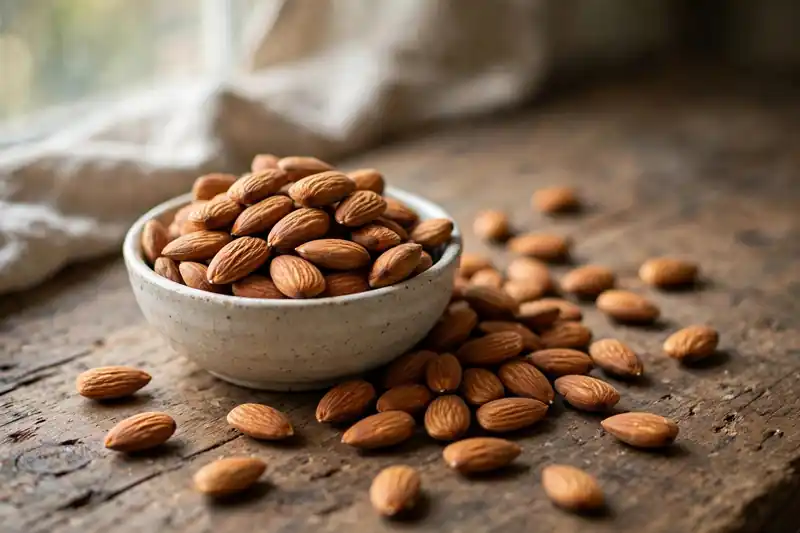
Full Nutrition Facts (USDA FoodData Central, raw almonds)
The table below lays out almonds nutrition per 100g, per ounce, and per 10 almonds.
| Nutrient | Per 100g | Per 1 oz (28g) | Per 10 almonds (~12g) |
|---|---|---|---|
| Calories | 579 kcal | 164 kcal | 70 kcal |
| Protein | 21.2g | 6.0g | 2.6g |
| Total fat | 49.9g | 14.1g | 6.0g |
| Monounsaturated fat | 31.8g | 9.0g | 3.8g |
| Polyunsaturated fat | 12.3g | 3.5g | 1.5g |
| Saturated fat | 3.7g | 1.1g | 0.4g |
| Carbohydrates | 21.6g | 6.1g | 2.6g |
| Fiber | 12.5g | 3.5g | 1.5g |
| Sugars | 4.4g | 1.2g | 0.5g |
| Calcium | 269mg | 76mg | 32mg |
| Magnesium | 270mg | 77mg | 32mg |
| Potassium | 733mg | 208mg | 88mg |
| Vitamin E | 25.6mg | 7.2mg | 3.1mg |
| Riboflavin (B2) | 1.14mg | 0.32mg | 0.14mg |
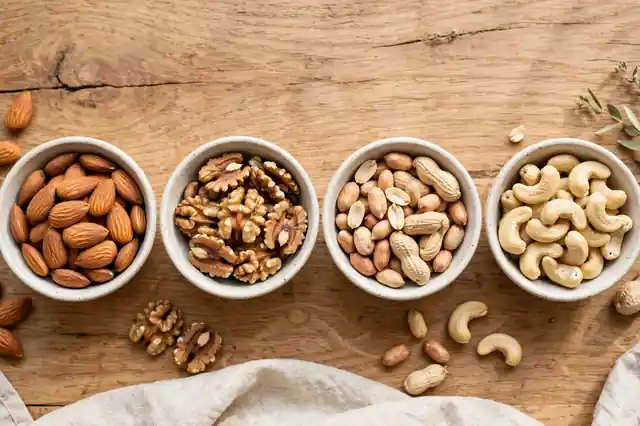
Almonds vs Other Nuts (per 1 oz / 28g)
| Almonds | Walnuts | Peanuts | Cashews | |
|---|---|---|---|---|
| Calories | 164 kcal | 185 kcal | 161 kcal | 157 kcal |
| Protein | 6.0g | 4.3g | 7.3g | 5.2g |
| Fat | 14.1g | 18.5g | 14.0g | 12.4g |
| Fiber | 3.5g | 1.9g | 2.4g | 0.9g |
| Vitamin E | 7.2mg | 0.2mg | 2.4mg | 0.3mg |
| Omega-3 (ALA) | ~0g | 2.6g | ~0g | ~0g |
| Calcium | 76mg | 28mg | 26mg | 10mg |
Almonds win on protein (among tree nuts), fiber, vitamin E, and calcium. Walnuts win on omega-3s. Peanuts win on protein overall and price.
On almonds vs peanuts protein specifically: peanuts have about 7g per ounce versus 6g in almonds — close — but almonds win on fiber and vitamin E. There is no single “healthiest nut”; rotate them.
The Fat Profile: Why It Is Genuinely Good
About 64% of almond fat is monounsaturated (mostly oleic acid, the same fat that makes olive oil valuable), ~25% polyunsaturated, and only ~7% saturated. That fat profile is the foundation of the almonds nutrition story: mostly monounsaturated, very little saturated. Replacing foods high in saturated fat with unsaturated-fat foods like almonds can support healthier LDL cholesterol levels. The fat also helps you absorb fat-soluble vitamins (A, D, E, K) from foods eaten alongside, so a handful of almonds on a salad does more than add crunch.
Evidence-Based Benefits
- Heart health: Almonds have one of the stronger evidence bases among nuts — trial meta-analyses suggest modest LDL-cholesterol reductions. Effects vary, and almonds work as part of an overall heart-healthy pattern, not on their own.
- Vitamin E: One ounce covers roughly half the adult daily value — almonds are among the richest common food sources of it.
- Blood sugar: The fat-fiber-protein combo slows carbohydrate absorption somewhat, and eating almonds with carb-heavy meals may soften the glucose response — but research does not show a reliable blood-sugar-lowering effect, so do not count on them as a control strategy.
- Bone support: 76mg of calcium per ounce (about 6% of the daily value), plus magnesium — a useful contribution, though almonds are not a major calcium source.
How Many Almonds Per Day?
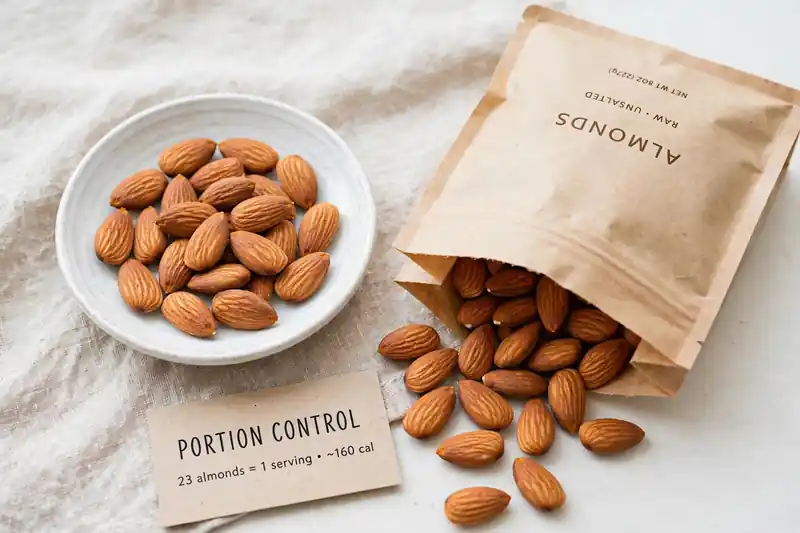
About 1 ounce, roughly 23 whole kernels, is the standard serving used in most research. That is a small handful, not a bowl. Pre-portion into small bags or containers; eating from the bag is how 164 calories becomes 500.
The Downsides (Honest Version)
- Calorie density: 164 calories per small handful adds up fast. “Healthy” does not mean unlimited — this is the #1 almond mistake.
- Oxalates: Almonds are high in oxalates. If you have a history of calcium oxalate kidney stones, ask your doctor or dietitian whether you need to limit them — blanket restriction is not right for everyone.
- Allergies: Tree nut allergies can be severe. This is not a food to “try and see.”
- “Superfood” hype: Almonds are excellent, not magical. No single food meaningfully changes health outcomes alone; dietary patterns do.
Raw vs Roasted
Nutritionally almost identical. Dry-roasted almonds have marginally less vitamin E (heat-sensitive) and the same calories. Oil-roasted add a little fat. Avoid “honey roasted” and heavily salted varieties if sugar or sodium is a concern; plain raw or dry-roasted is the best default.
Almonds, By Goal
For Weight Loss
Almonds work for weight loss only in measured portions. The protein-fiber-fat trio is very satisfying — 1 oz as a mid-afternoon snack can help tide you over to dinner (appetite responses vary). But they are 579 calories per 100g, so unmeasured handfuls will quietly erase a calorie deficit. Measure out about 23 kernels and put the bag away — measured portions are the whole game.
For Weight Gain
Almonds are a clean calorie booster: 1 oz adds 164 calories with 6g protein and real micronutrients. Two handfuls a day is ~330 extra calories without any cooking. Almond butter on toast, oats, or smoothies pushes it further — 2 tablespoons of almond butter typically carry ~190-200 calories (varies by brand).
For Muscle Building
At 6g of protein per ounce, almonds are a supplement to, not a foundation of, a muscle-building diet. Their real contribution is calories, vitamin E (antioxidant), and magnesium (involved in muscle function). Aim for roughly 1.4-2.0g/kg of protein a day from complete sources (dairy, eggs, meat, soy) if you train hard — needs vary — and let almonds fill the healthy-fat and calorie gaps. That is the right way to use almonds nutrition in a muscle-building diet: fats and calories from almonds, protein from complete sources.
Frequently Asked Questions
How many almonds should I eat a day?
About 23 whole almonds (1 oz / 28g), the standard research serving with 164 calories and 6g protein.
Are walnuts healthier than almonds?
Different strengths. Walnuts have far more omega-3 (ALA); almonds have more protein, fiber, vitamin E, and calcium. Eating both beats picking one.
Is there any downside to eating almonds?
Calorie density (easy to overeat), oxalates (kidney-stone risk), and tree-nut allergies. For most other adults, a measured ounce a day fits a balanced diet.
How much protein is in 1 oz of almonds?
6 grams, with 164 calories and 14g of fat. That 6g, combined with fiber and fat, is why almonds nutrition works so well for between-meal satiety.
Are almonds good for weight loss?
Yes, in a measured 1-oz portion — satisfying for 164 calories. Eaten unmeasured from the bag, no: the calories quietly erase the deficit. The almonds nutrition verdict for dieters is simple: the food is excellent, the portion is everything.
Why do some say almonds are “no longer a superfood”?
Mostly hype-cycle backlash. Almonds genuinely provide vitamin E, fiber, and unsaturated fats, and trials support modest LDL benefits — but no single food deserves the “superfood” label, and appetite effects vary.
Almonds nutrition is excellent — vitamin E, magnesium, healthy fats — as long as portions stay measured.
Sources
- USDA FoodData Central: Almonds, raw (representative nutrient values).
- Harvard T.H. Chan School of Public Health, The Nutrition Source: Almonds (fat composition, serving guidance).
This article is for general information only and is not medical advice. Talk to a registered dietitian or your doctor about your personal nutrition needs.